
There are three ways into this career, and most people asking the question want the same one. This guide walks through that path step by step, what it actually costs, how you get paid, and who should skip it.
By Favorite Grampy | Reviewed by Nikki Hendrix, CEO and Founder | Last Updated: September 2026 | Costs, credentials and state registration verified against government and industry sources
What Are the Steps to Become a Travel Agent?
There are three paths. You can be an employee, an independent contractor under an established agency, or an owner. Most people asking this question want the middle one, an independent business run under an agency’s credentials, and that is the path this guide follows.
Most travel agents are employees. The U.S. Bureau of Labor Statistics puts 72 percent in travel arrangement and reservation services and 12 percent self-employed, and companies like Disney Cruise Line hire salaried vacation agents directly.
This guide covers the independent path, because it is the one most people asking the question actually want and the one Favorite Grampy Travels uses. Here are its five steps:
- Choose an agency and apply.
- Pass a background and credit check.
- Pay your startup cost. At Favorite Grampy Travels that is $197 onboarding plus $315 for the year, collected together at signup.
- Complete your training. Supplier programs run anywhere from an afternoon to two weeks.
- Start selling. You earn a share of the commission the supplier pays, which here runs from 60 to 85 percent.
In fact, most people reading this already do the work for nothing. They are the ones planning every trip for their family and fielding questions from friends. This guide is for them, and it answers the three things they actually want to know: what it costs, how the money works, and whether it is a real business.
One thing to settle up front. There is no national travel agent license, no required degree, and no certification you must buy before you begin.
| Step | What It Involves | What It Costs | How Long |
|---|---|---|---|
| 1. Apply | Application, interview, background and credit check | No cost to apply | Set by the agency |
| 2. Sign on | Independent contractor agreement, systems access | $512 at signup at Favorite Grampy Travels ($197 onboarding plus $315 for the year) | A few days |
| 3. Train | Supplier training programs through your agency | Included with your agency | An afternoon to two weeks |
| 4. Sell | Quote and book clients through agency systems | No added cost | Ongoing |
| 5. Get paid | Commission split, paid twice a month by direct deposit | 60 to 85 percent split here | On the supplier’s schedule, from final payment to after travel |
Swipe left to see all columns on mobile.
Travel Agent Quick Facts
Do you need a license to become a travel agent?
No national license exists. Four states require a seller of travel registration, normally held by the agency rather than by you, and your agency should tell you at onboarding which states it covers.
How much does it cost to become a travel agent?
At Favorite Grampy Travels, $512 at signup, which is a $197 onboarding fee plus $315 for the year. There is no monthly minimum and nothing to buy.
How do travel agents get paid?
Suppliers pay the agency a commission on their own schedule, some at final payment and many after the client travels, and the agency splits it with the advisor. Splits here run 60 to 85 percent, paid twice monthly.
How do you tell a good agency from a bad one?
Look at what it does for you in year one. Favorite Grampy Travels was named Best Company to Work For in the 2026 Best of Loudoun awards, alongside Best Boss, Best Woman-Owned Business, and Best Minority-Owned Business.
What Does It Cost to Become a Travel Agent?
Expect $200 to $600 in your first year. At Favorite Grampy Travels it is $512. That covers a $197 onboarding fee plus $315 for the year, collected together when you sign on, and the recurring cost after that is the $315 alone.
That annual portion pays for your agency email, your biography page on the website, and the system you quote and track clients in. There is no monthly minimum, no inventory and no sales quota.
Meanwhile, the wider market runs from that figure up to genuinely expensive. A travel franchise can cost tens of thousands. A self-paced certification course sold by a community college runs about $2,349, and it is optional, not a requirement.
Here is the part that matters more than the number. Any operation asking for thousands up front, or selling a “travel agent card” as the product, is not an agency.
The American Society of Travel Advisors warns about these outfits directly, noting the credentials are sold at a significant fee while buyers are led to believe the cards allow travel at reduced fares.
How Do Travel Agents Get Paid?
Travel advisors earn commission from suppliers, not a salary. The supplier pays the agency, and the agency splits that commission with you. At Favorite Grampy Travels that split runs from 60 to 85 percent, and when the money arrives depends on what you sold.
Two details catch new advisors off guard. First, commission arrives on the supplier’s schedule, not at booking. Most hotels pay after travel and several cruise lines pay at or near final payment, so a family booking in January for an August resort stay can mean roughly seven months between your work and your payment.
Second, the supplier rate your client pays is the same published rate they would find booking direct, and at times an unpublished rate the public cannot see. Your planning fee is a separate charge for your time, quoted and agreed before anything is booked, and the advisor keeps 85 percent of it. You can see how that works on the agency’s planning fee page.
The split is a share of the agency’s commission, not of the vacation price. If a supplier pays the agency $1,000 on a booking and your split is 60 percent, you receive $600 before taxes and business expenses. The full arithmetic, including what a $10,000 booking actually pays and when, has its own guide.
Payments here go out twice a month by direct deposit. Advisors earn their full split on agency-provided leads rather than a reduced rate, and 100 percent of the commission on their own personal travel from their first day.
Do You Need a License to Sell Travel?
No national travel agent license exists in the United States. Four states require a seller of travel registration. Those are California, Florida, Hawaii and Washington, and in each one the registration is normally held by the agency rather than by you personally.
Each state runs its own program. California registers sellers through the Attorney General’s Seller of Travel Program, Hawaii through the Department of Commerce and Consumer Affairs, and Washington through the Department of Licensing.
What that means for you is that the agency carries the registration. A good one tells you at onboarding which states it holds and whether you have any filing of your own, and puts it in writing before you sign.
Florida has a filing of its own for some individual advisors. Some independent agents register with the Florida Department of Agriculture and Consumer Services for $50 a year, under the agency’s umbrella. What Florida actually requires of an advisor, including the state’s own definition of who files, is covered separately.
One correction worth making: Iowa repealed its travel agency registration law in 2020, so any list still naming five states is out of date.

Can You Become a Travel Agent for Free?
Some agencies do offer a no-fee start. So the answer is yes, with real conditions attached. Around 720 people a month search this question, and it deserves a straight response rather than a recruiting pitch dressed up as helpful advice.
Running an agency costs money. Insurance, supplier contracts, booking systems, state registrations and training all carry real bills, and somebody pays them. A no-fee agency usually recovers that by keeping a larger share of your commission, offering less support, or setting production requirements.
So a fee is not a badge of quality and no fee is not a warning sign. Compare the total annual cost against the split, the training, the lead program, who owns the bookings, and what the contract says about leaving.
That said, watch the size and the shape of it. A few hundred dollars is normal, thousands is not, and any sign-up that later asks you to recruit other agents is a different business entirely.
Beyond that, watch what the fee actually buys. At Favorite Grampy Travels it covers onboarding, your agency email, your bio page and system access for the year, and the agency carries a basic errors and omissions policy for you.
What Favorite Grampy Travels Actually Does for You in Year One
More than a login. Mentors are organized by destination, in mentorship groups rather than one-to-one pairings. You start with the mentor for what you know best and can use any of the others, during onboarding and after, and advisor development has a name attached to it, Kirsten Andrade, the agency’s Director of Operations and Travel Advisor Development.
Training is included and it is real. Disney’s advisor program runs up to two weeks, and supplier training for Universal and the cruise lines is included as well.
Leads come to you as well, and this is where being an award-winning agency pays off. Favorite Grampy Travels receives hundreds of trip requests a month through its website, its Facebook communities and its supplier lead programs, and it passes them to advisors who have earned expert status. That status comes with sales thresholds and standards for how every client is looked after, and taking part in the program is voluntary.
Expert status is earned on sales and on how you look after clients, and a few early bookings do not get you there, so plan your first year around the people who already know you and treat agency requests as something to grow into. Once they do come, speed matters. A Harvard Business Review study of 2,241 American companies found that firms that tried to contact a lead within an hour were about seven times as likely to qualify it as firms that waited even an hour longer, and about 60 times as likely as those that waited a day or more.
So a request that lands with you is expected to get a fast answer, and when you book it you earn your full split on it, not a reduced rate.
Then there is the part that makes this fun. New advisors start in a cohort, the whole agency meets on a monthly Family Table Zoom call, there are FAM trips and an annual Connections Conference in Orlando, and a private community of about 80 advisors answers each other’s questions at six in the morning when a dining window opens. You also earn 100 percent of the commission on your own personal travel from day one, because the agency wants you in the parks and on the ships learning what you sell.
The split starts at 60 percent and climbs toward 85 as your cumulative sales pass set levels, so selling more raises your share of each booking. Nobody here draws a salary, so nobody here is capped by one.
I am not going to promise you a number, because I have not met you yet. I will show you the arithmetic instead, the split, the pay schedule, and what a booking actually pays, and let you do the math on your own year.
This is the agency the Loudoun Times-Mirror named Best Company to Work For in 2026, the same year it named Nikki Hendrix, who founded it and still runs it, Best Boss. The advisors put it better than I can, in reviews they posted publicly.
The other mentors and advisors actually make time to help. We share ideas, travel together, encourage each other, and just show up as real people. There’s no competition, just a whole lot of support and heart.
Nicole Damiano, Favorite Grampy Travels advisor
We uplift and empower each other through ongoing training opportunities, monthly Zoom calls, one-on-one mentoring with agency leaders, and active chat groups where we can share advice and celebrate wins.
Diana Richardson, Favorite Grampy Travels advisor
Who Owns the Booking, and What Happens If You Leave?
Nobody owns the client, and the agency owns the booking. Bookings sit under its credentials and its insurance, which is why. A family is free to work with whoever they like on their next trip, and that answer belongs in writing before you sign.
If you leave, the bookings you made stay with the agency and another advisor takes over servicing them. The agency still pays you half of its gross commission on each of those bookings once it travels, so the work you already did is not simply written off.
The $512 is collected only after you are approved to start, never before, and onboarding and technology dues are never refunded, including if you leave in your first month. So treat signing as the real decision rather than the application, and take the conversation before it seriously.
Ask any agency the same three questions before you sign, and get the answers in writing: who owns the booking, what happens to your commission if you leave, and what is refundable. An agency that hesitates on the first one has answered a different question.
Do You Need Experience or a Degree to Start?
No degree and no prior industry experience are required. No certification is required either. What agencies actually screen for is travel you have done yourself, trips you have planned for other people, and whether you follow through on what you promise.
Favorite Grampy Travels accepts both beginner and experienced advisors, and new advisors work with the agency’s destination mentors from the start. The application asks how many times you have visited Disney or Universal in the last ten years, which destinations you know best, and why you want to do this.
Of course, there is a screening step people rarely expect. Applicants complete a background and credit check, which is standard for anyone who will be handling client bookings and payment information.
For example, the advisors here came from teaching, nursing, accounting, and full-time parenting. Very few came from travel. What they had in common was that they were already the person everyone in their circle called before booking a trip.
Can You Become a Travel Agent From Home?
Yes, and for independent advisors it is the normal arrangement. Every advisor at Favorite Grampy Travels works from home. What you need is a computer, reliable internet, a phone and somewhere quiet to take a call, which is why startup costs stay in the hundreds.
There is no office to rent and no inventory to store. That is the whole reason a travel business starts for a few hundred dollars when most small businesses start for tens of thousands.
The part people underestimate is the phone. Clients call when something goes wrong on their trip, and that means evenings, weekends and the occasional 6 a.m. dining window.
For example, a cancelled flight on a Saturday afternoon is not something you can leave until Monday. Working from home means the job is always ten feet away, and that cuts both ways.
What Is a Host Agency?
A host agency lets independent advisors sell under its credentials and supplier contracts. The advisor still runs their own business. The agency supplies the accreditation, the supplier relationships, the booking systems and the back office that make those bookings possible.
The arrangement exists because the credentials that permit travel sales are issued to agencies, not to individuals. Accreditation from IATAN, agency membership with CLIA, and an ARC number are all held at the agency level, and suppliers pay commission against those numbers.
Naturally, that raises the obvious question about personal credentials. Individual cards exist and their rules differ. The IATAN ID card sets a production test of 20 hours a week and $5,000 earned in the prior year, while CLIA individual membership turns on affiliation and good standing with a member agency.
Either way they come later, and neither is a startup cost or an onboarding step. Any agency presenting a personal card as something you buy in week one has the sequence wrong.
Favorite Grampy Travels works on exactly that arrangement: advisors run their own businesses and sell under the agency’s accreditation and supplier contracts. The agency was founded in 2019, works with roughly 80 independent advisors nationwide, carries CLIA and IATA accreditation, belongs to the American Society of Travel Advisors, and keeps offices in Leesburg, Virginia and Celebration, Florida.
What Can You Actually Sell as a New Advisor?
Whatever your agency holds contracts for. For most family-focused agencies that means theme parks, cruises, all-inclusive resorts and packaged vacations. Your first bookings will almost always come from the destinations you already know well enough to answer a stranger’s questions about.
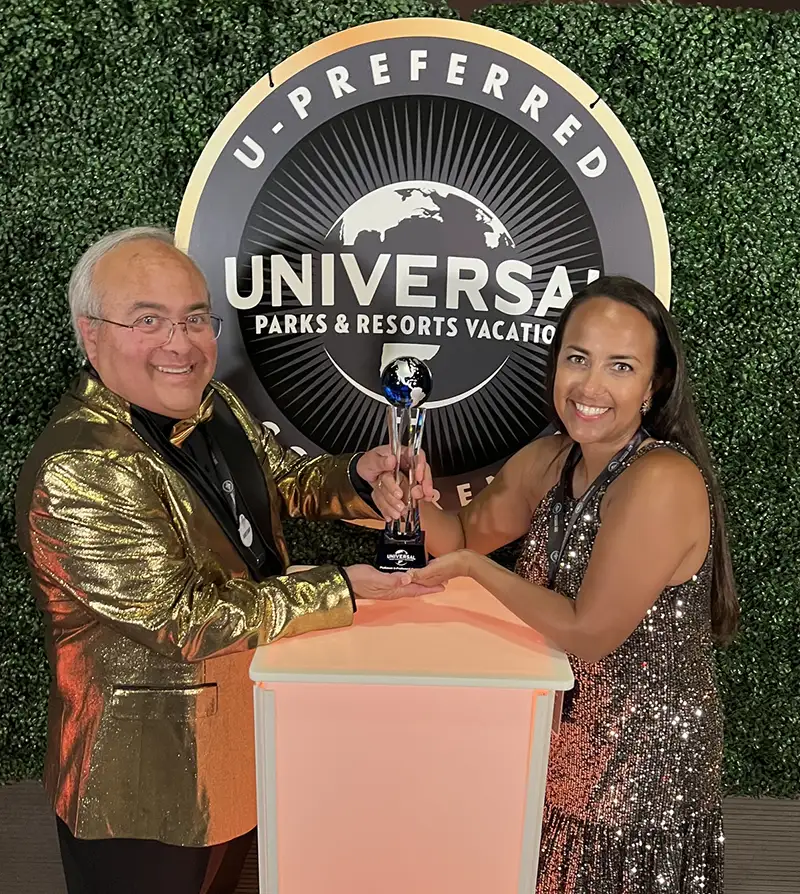
Favorite Grampy Travels advisors sell Walt Disney World and Disneyland, Universal Orlando including Epic Universe, Disney Cruise Line and Royal Caribbean, and all-inclusive resorts. The agency holds Authorized Disney Vacation Planner status and Official Universal U-Preferred Platinum status, which is an unusual pairing across two competing park companies. Theme parks are about 60 percent of what the agency books, with cruises and international travel at roughly 20 percent each, and once you are comfortable you can narrow to the niche you know best.
Better still, specializing early beats selling everything. An advisor who knows one destination properly gets referrals faster than one who claims all of them. Families talk to each other, and they remember who actually knew the answer.
Each supplier has its own training, and the depth varies. Disney’s advisor training, for example, runs through its trade portal and takes up to two weeks to complete rather than an afternoon.
How Much Can You Realistically Earn?
No reliable published figure exists for independent advisors. Anyone quoting you one is guessing. The nearest real data point comes from the federal Bureau of Labor Statistics, and it explicitly excludes self-employed workers, which is exactly what an independent advisor is.
The figure itself is worth knowing. BLS puts the median annual wage for travel agents at $50,160 as of May 2025, and says plainly that it does not collect pay data for the self-employed.
What drives income is volume and destination mix. A packaged theme park vacation for a family of four pays far more commission than a two-night hotel booking, and a seven-night cruise for two families pays more than either.
Even so, the demand is real. The American Society of Travel Advisors reports that about 25 percent of travel is booked through an agency, and that more than 60 percent of cruise bookings are. It projects agency sales will reach $165 billion by 2028.
Who Should Not Become a Travel Agent?
Plenty of people, and I would rather say so now. Better to talk you out of it early. Three kinds of people should skip this work, and I would rather you hear that before you pay to start than after.
Skip it if you need income this quarter. Commission arrives on the supplier’s schedule rather than at booking, so your first meaningful payment can be months away and nothing bridges that gap.
Skip it if you enjoy planning but not selling. The planning is the smallest and most pleasant part of the job. The rest is follow-up, availability when a flight cancels, and a text about dining reservations at 6:45 in the morning.
What’s more, skip it if the travel discounts are the draw. Agent rates are real but they are earned through accreditation and training, checked against a photo credential at the front desk, and cannot be shared with family or friends. That said, if you already plan everyone’s trips for nothing and you like the selling more than you expected to, this fits you better than most work will.
Still reading and still interested? That is usually the answer. Start with the advisor application, and nothing is signed until you have talked to a person.
What Should You Look For in a Travel Agency?
Judge an agency by what it gives you in year one. That is when you have no clients and no momentum. Everything else, including the headline commission split, matters less than whether someone actually helps you land your first booking.
Ask every agency these four questions in writing:
- What is the total cost, both at signup and each year after?
- What is the commission split, and does it move as I produce?
- Do leads come to me, or do I build entirely from zero?
- Who helps when a client has a problem at 9 p.m. on a Saturday?
Ask Favorite Grampy Travels those four questions and get the answers in writing before you sign; the numbers are already named above. The year-one section earlier on this page says what the mentors, the lead program, the training and the convention actually look like.
The agency was named Best Company to Work For in the 2026 Best of Loudoun awards, along with Best Boss, Best Woman-Owned Business and Best Minority-Owned Business. It has been recognized among the county’s travel agencies for seven consecutive years, 2020 through 2026.
Beyond that, read the people. You can look through the team’s advisor biographies and see what everyone did before this.
Frequently Asked Questions About Becoming a Travel Agent
How Long Does It Take to Become a Travel Agent?
Faster than most careers, because there is no exam and no license to wait for. The only clock is the agency’s onboarding and the supplier training, and the longest supplier program a new advisor here completes, Disney’s, takes up to two weeks. Most of the time between applying and your first booking goes into learning the products and talking to the families who already trust you, not into paperwork.
The truth is that the paperwork moves faster than the skill does. Being able to book in a month is not the same as being ready to handle a family’s ten thousand dollar vacation. My advice is to spend those first weeks quoting for friends who will forgive a slow answer, because that is where you learn what clients actually ask.
Can You Be a Travel Agent as a Side Hustle?
Yes, and a large share of travel advisors work part time alongside another job. Advisors at Favorite Grampy Travels set their own hours and work from home, so the schedule bends around whatever else you have going on.
What actually matters is availability rather than total hours. Theme park dining windows open early, cruise promotions move fast, and a client whose flight just cancelled needs you that afternoon, so the job fits around a nine to five better than around shift work. I have advisors doing twenty hours a week and thriving, and others doing five and treating it as a hobby that pays for their own trips.
Do You Need an LLC to Be a Travel Agent?
No LLC is required to work as an independent travel advisor. You can operate as a sole proprietor from day one, and most new advisors do exactly that for their first year.
What that means in practice is that you can start without a lawyer or a filing fee. An LLC becomes worth considering once you have steady income and want the liability separation, which is a conversation for an accountant rather than for me. I would not let the question delay your start: get a few bookings down, see whether this is going to be real for you, then structure it properly.
Do You Need Travel Agent Certification?
No certification is required to sell travel, though several optional programs exist. The Travel Institute offers CTA, CTC and CTIE credentials, and a self-paced community college course runs around $2,349, but none is a prerequisite for booking a client.
What actually opens doors is supplier training, which your agency arranges and the suppliers themselves run. I would spend your first year on those instead of a paid certificate, because a completed Disney or Universal program tells a client something specific about the trip they are about to book. A general certificate mostly tells them you bought a certificate.
Is Becoming a Travel Agent Worth It?
Becoming a travel agent is worth it if you enjoy the selling and the service as much as the planning, and a poor fit if you only enjoy the planning. At $512 to start, the financial risk is small compared with almost any other small business.
The real cost is time and patience, because you are building a client base from nothing and working for months before you are paid for it. What I tell people is to give it a full year before judging it, since year one is investment and year two is where the referrals start compounding. If you cannot commit that long, wait until you can.
Ready to Start as a Travel Agent?
Favorite Grampy Travels is accepting both beginner and experienced advisors right now.
You will answer a few questions about how much you travel, which destinations you know best, and why you want to do this. Someone on the team reads every application. If it looks like a fit, you talk with a real person before anything is signed, and you get the full cost and commission structure in writing first.
The advisor application is below, the same one that lives on the Work with Us page. Not ready to apply? The agency holds occasional Zoom sessions on becoming a travel advisor, announced on Facebook, and you are welcome to sit in on one first.
One thing worth saying plainly. Favorite Grampy Travels recruits independent advisors and the agency benefits when someone joins. That is exactly why this guide publishes its own numbers instead of keeping them vague, and the comparison questions above work just as well on any agency you talk to.
Of course, some readers land here wanting to hire an advisor rather than become one. If that is you, reach out to the team instead and we will match you with someone who knows your destination. Our travel agent FAQ answers the questions families ask most.